
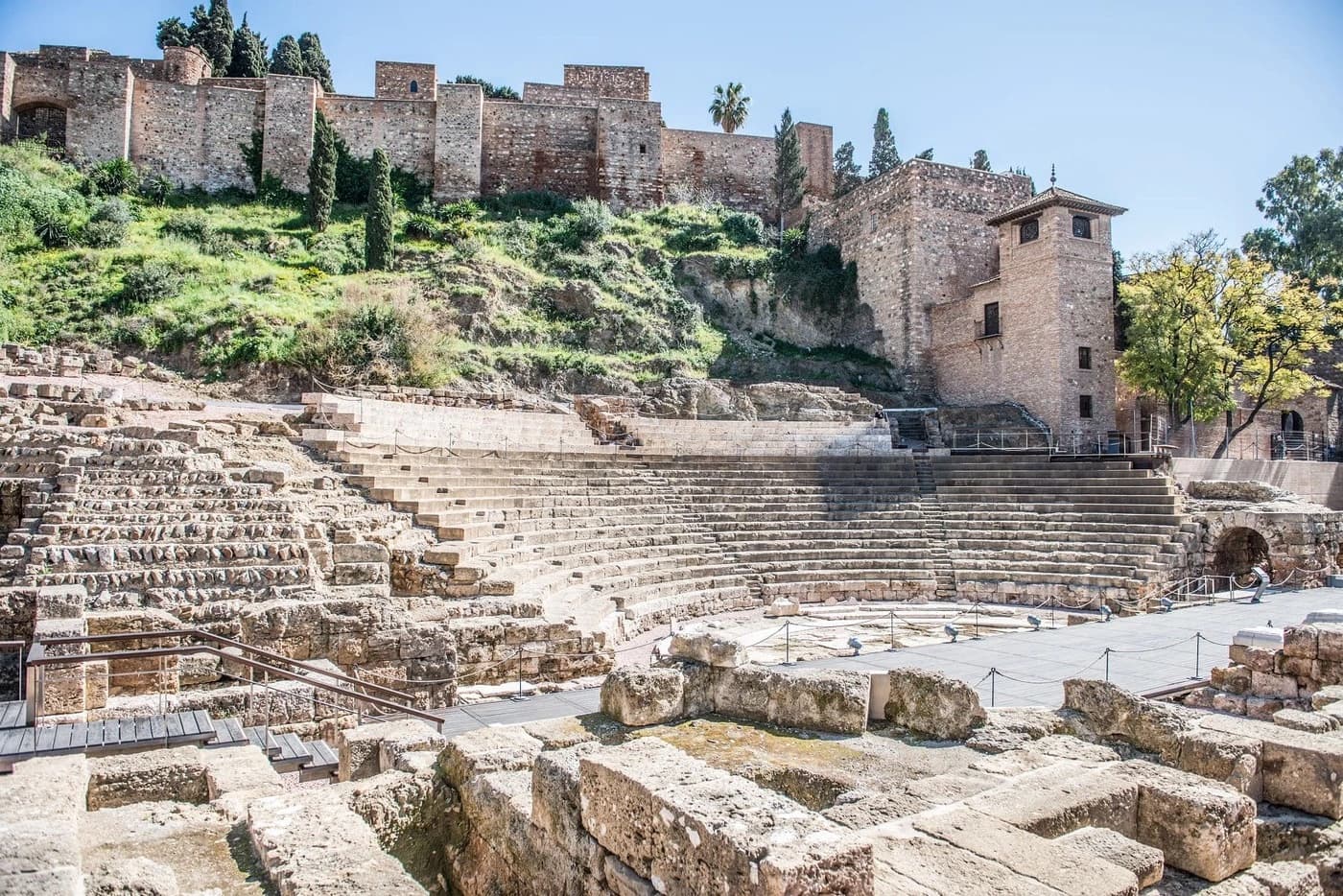
Alcazaba de Málaga sobre el Teatro Romano
Monument guide

What to see at Malaga's Alcazaba

The Alcazaba of Málaga brings together, within the same walled enclosure, several areas that correspond to different functions. The entrance fortifications concentrate the defensive system that protected access from the city. The lower enclosure preserves remains of a residential quarter that shows there were not only soldiers here. And the upper enclosure holds the palaces and the Keep, the political and residential heart of the site.

Below you can see how the Alcazaba is organised and what you will find in each of its main areas, so you can plan the visit and decide what to prioritise.

Tours with an official guide

How the visit to the Alcazaba is organised

The site is explored from the bottom up, following the logic of the fortress itself. First the entrance defences, with the bent gates and the towers that protected access. Then the lower enclosure, where the daily life of the complex appears. And finally the upper enclosure, with the palaces and the keep at the highest point.

This layout directly affects how the visit is organised. With the general ticket you access the whole enclosure and can explore it at your own pace; with the guided visit, the guide follows this same ascending order while explaining each area.

Entrance fortifications

Alcazaba de Málaga sobre el Teatro Romano01

Area 01

Torre Albarrana

The Albarrana Tower is the first thing that signals the presence of the fortress as you approach from the city. It stands apart from the main wall and is connected to it by a walkway, which made it possible to control any blind spot of the curtain wall and watch over access from the sea side.

In Islamic times the tower reached into the city at the water's edge. Its interior preserves three small floors, with rooms covered by vaults, from which the surroundings were watched.

This area is covered in Guided tour of the Alcazaba and Roman Theatre
Alcazaba de Málaga sobre el Teatro Romano02

Area 02

Vaulted dome gate (puerta de la bóveda vaída)

The Gate of the Sail Vault is the first bent gate of the fortification. The tower that houses it dates from the 11th century, and the bent layout forced anyone entering to turn, slowing the attack and exposing them to the defenders.

The vault that gives it its name is a lowered spherical sail vault made of brick, with the keystone formed by a circle of bricks. It is one of the oldest elements of the whole enclosure.

This area is covered in Guided tour of the Alcazaba and Roman Theatre

Alcazaba de Málaga sobre el Teatro Romano03

Area 03

Gate of the columns

The Gate of the Columns is named after what you see when you cross it: two imposing fluted shafts with large capitals, reused from the Roman Theatre below. It is the clearest example of how the Alcazaba was built with materials from the ancient city.

It is the point of the route where the connection between the theatre and the Alcazaba stops being a fact and becomes something you can touch.

This area is covered in Guided tour of the Alcazaba and Roman Theatre

Alcazaba de Málaga sobre el Teatro Romano04

Area 04

Christ's gate (puerta del cristo)

The Gate of Christ is the second bent gate of the enclosure and gives access to the first walled enclosure. In the Christian period a chapel was set up in it, which is where its name comes from.

Opposite its exit, remains of Roman walls of concrete coated with reddish stucco and small Roman arches were found, which show that the hill was already occupied before the Islamic fortress.

This area is covered in Guided tour of the Alcazaba and Roman Theatre

Lower enclosure

Arcos del palacio de la Alcazaba de Málaga05

Area 05

Residential quarter

The military quarter preserves eight 11th-century dwellings in an exceptional state of conservation, precisely because the area was abandoned early and never rebuilt. They are organised around a central courtyard, with latrines, drains and a bathhouse.

Inside the dwellings, red-painted dados with Kufic inscriptions and geometric drawings appeared, together with everyday pottery that is now displayed in the Alcazaba itself.

This area is covered in Guided tour of the Alcazaba and Roman Theatre

Upper enclosure

Arcos del palacio de la Alcazaba de Málaga06

Area 06

Taifa Palace

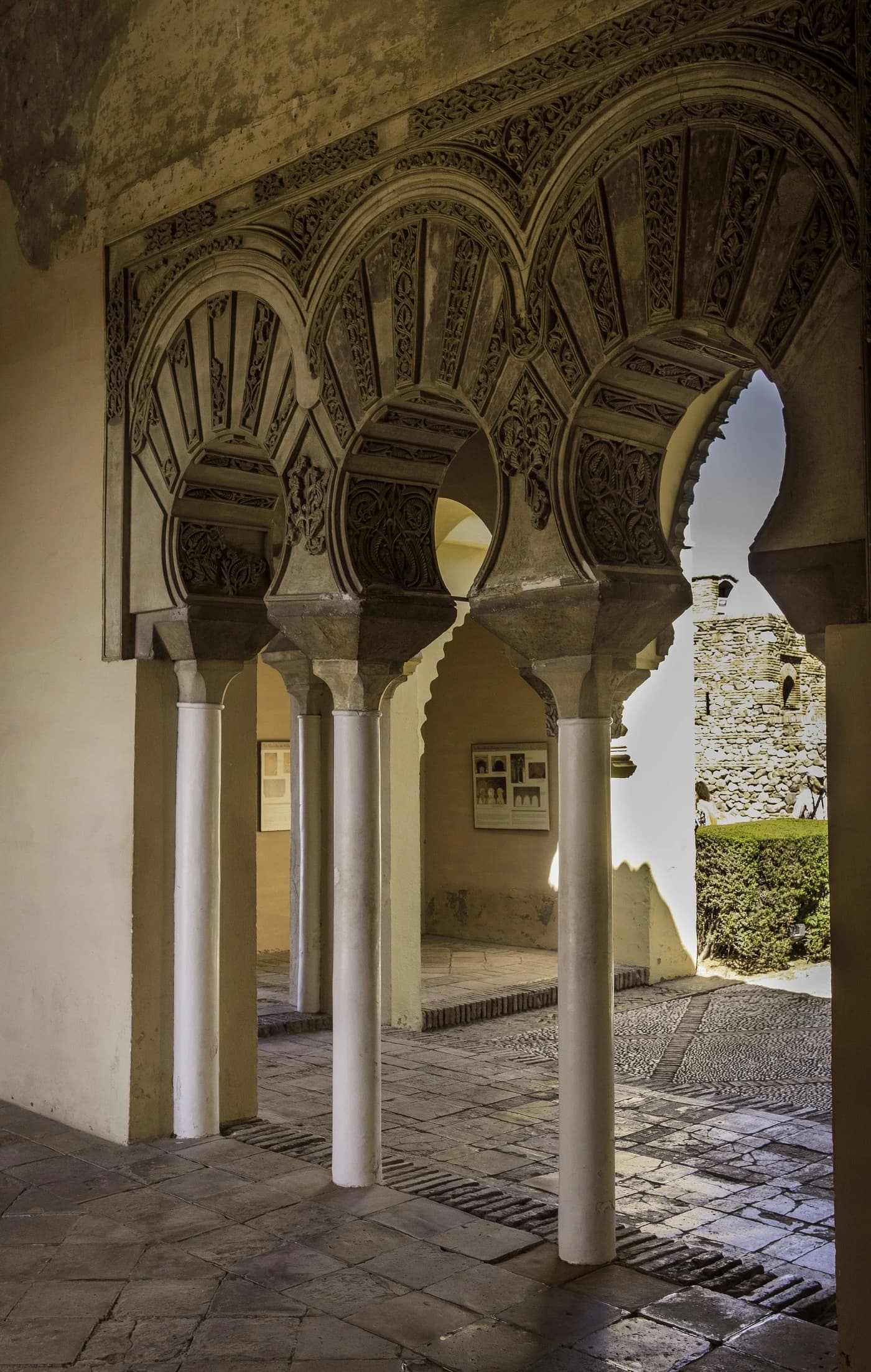
The Taifa Palace corresponds to the first palatine phase of the upper enclosure, built in the 11th century. Its centre is the Patio de los Surtidores, with a pavilion of three horseshoe arches on reused Roman columns.

It is, together with the military quarter, the most interesting space of the Alcazaba and the one that shows the greatest power and richness of the Taifa period, before Nasrid Granada.

This area is covered in Guided tour of the Alcazaba and Roman Theatre

Arcos del palacio de la Alcazaba de Málaga07

Area 07

Nasrid Palace

The Nasrid Palace corresponds to the phase when Málaga was part of the Kingdom of Granada (13th-14th centuries). It is organised around the Patio de los Naranjos and the Patio de la Alberca, with rooms and a tower-viewpoint over the city.

The ceilings of the rooms were recreated in the 1940s, inspired by ceilings of the Alhambra, completed with Nasrid-style plasterwork and tiles.

This area is covered in Guided tour of the Alcazaba and Roman Theatre

Alcazaba de Málaga sobre el Teatro Romano08

Area 08

Keep Tower (torre del homenaje)

The Keep is almost square in plan and closes the upper enclosure at its eastern end. It was initially the residence of the governor and later a defensive bastion, connected to Gibralfaro Castle by the coracha, the double wall that joins the two fortresses.

On 19 August 1487 the Catholic Monarchs raised the cross and the standard of Castile on this tower, bringing to an end five centuries of Islamic Málaga.

This area is covered in Guided tour of the Alcazaba and Roman Theatre

Alcazaba de Málaga sobre el Teatro Romano09

Area 09

Parade Ground (plaza de armas)

The Plaza de Armas is the largest flat area of the enclosure, from which almost the whole city is overlooked. During the Emirate and the Taifa it was the parade ground where troops were mustered; later it was turned into gardens.

Today it works as one of the best viewpoints in Málaga: the port, the historic centre, the Cathedral and the Mediterranean are all in sight from a single spot.

This area is covered in Guided tour of the Alcazaba and Roman Theatre

What to see at the Alcazaba on your first visit to Malaga

If it is your first time visiting the Alcazaba, the part that carries the most weight in the route is the upper enclosure with the palaces. The Taifa Palace and the Nasrid Palace concentrate the most complete reading of the monument.

The second priority depends on the type of visit you prefer. If you are interested in the defensive side, the entrance fortifications and the Keep explain better than anywhere else why this hill was chosen. If you prefer daily life, the residential quarter of the lower enclosure is the most surprising area.

And if you have time, going down to the Roman Theatre at its feet completes the visit. It is the same theatre that provided columns and capitals to the fortress, and seeing it afterwards helps to close the story.

Free visit to the Alcazaba

According to the official information, admission to the Alcazaba is free every Sunday from 14:00, and children under 6 never pay admission to the monument. This is a self-guided visit, without a guide.

If you prefer to understand what you are seeing, the guided tour of the Alcazaba and Roman Theatre includes admission and an official guide.

How long does it take to see the Alcazaba

On your own, the visit to the Alcazaba takes about one hour, depending on how long you stop at each area. With the 1h 30min guided tour the route starts at the Roman Theatre and climbs up to the palace area.

Accessibility and slopes

The climb to the Alcazaba has slopes, cobbled ground and steps. According to the official website, a lift on Calle Guillén Sotelo goes up to the palace area.

If you want to add Gibralfaro Castle to your visit, the combined ticket is managed on the official website.